The United States has long been known as a nation of immigrants and diversity. Over the last century, significant demographic changes have occurred due to immigration patterns, birth rates, cultural shifts, and changing social values. This report outlines how the racial, regional, religious, and national origin composition of the U.S. population has evolved — and where it’s heading.
Table 1: U.S. Population by Race/Ethnicity (1960–2024)
| Year | White (Non-Hispanic) | Black | Hispanic/Latino | Asian | Native American | Multiracial | Other |
|---|---|---|---|---|---|---|---|
| 1960 | 85% | 10.5% | 3.5% | 0.5% | 0.3% | — | 0.2% |
| 1980 | 80% | 11.5% | 6.4% | 1.5% | 0.6% | — | 0.3% |
| 2000 | 69% | 12.3% | 12.5% | 3.6% | 0.9% | 2.4% | 0.3% |
| 2020 | 59.3% | 13.4% | 18.5% | 5.9% | 1.3% | 2.8% | 0.1% |
| 2024* | 57.1% | 13.2% | 19.1% | 6.5% | 1.4% | 3.1% | 0.2% |
Over the last six decades, the regional distribution of the U.S. population has undergone a substantial transformation. Economic shifts, climate preferences, and immigration patterns have contributed to the steady rise of the South and West as the primary hubs of growth, while the Northeast and Midwest have seen their shares of the national population gradually decline.
The United States Census Bureau divides the country into four main regions: Northeast, Midwest, South, and West. Over the past several decades, regional population distribution has shifted significantly due to migration trends, job availability, climate preferences, and immigration.
| Region | 1960 | 1980 | 2000 | 2020 | 2024 (Est.) |
|---|---|---|---|---|---|
| Northeast | 25% | 22% | 19% | 17% | 16.5% |
| Midwest | 29% | 27% | 23% | 20% | 19.7% |
| South | 31% | 34% | 36% | 38% | 39.2% |
| West | 15% | 17% | 22% | 25% | 24.6% |
Key Takeaway: The South and West have seen consistent growth due to warmer climates, job markets, and immigration hubs (e.g., Texas, Florida, California).
The religious landscape of the United States has undergone a dramatic transformation over the past 70 years. While the country once identified overwhelmingly as Christian — particularly Protestant — more Americans today are choosing no religious affiliation, a trend that reflects shifting cultural norms, generational change, and growing diversity.
| Religion | 1950 | 1980 | 2000 | 2020 | 2024 (Est.) |
|---|---|---|---|---|---|
| Protestant | 69% | 56% | 51% | 40% | 39% |
| Catholic | 25% | 27% | 24% | 21% | 20% |
| Jewish | 3% | 2.5% | 2% | 1.8% | 1.8% |
| Muslim | <0.1% | 0.5% | 1% | 1.3% | 1.5% |
| Hindu/Buddhist | <0.1% | 0.5% | 1.5% | 2% | 2.2% |
| Unaffiliated | 2% | 7% | 15% | 27% | 29% |
Key Shift: The rise of the “nones” (religiously unaffiliated) is among the most dramatic religious shifts in recent history.
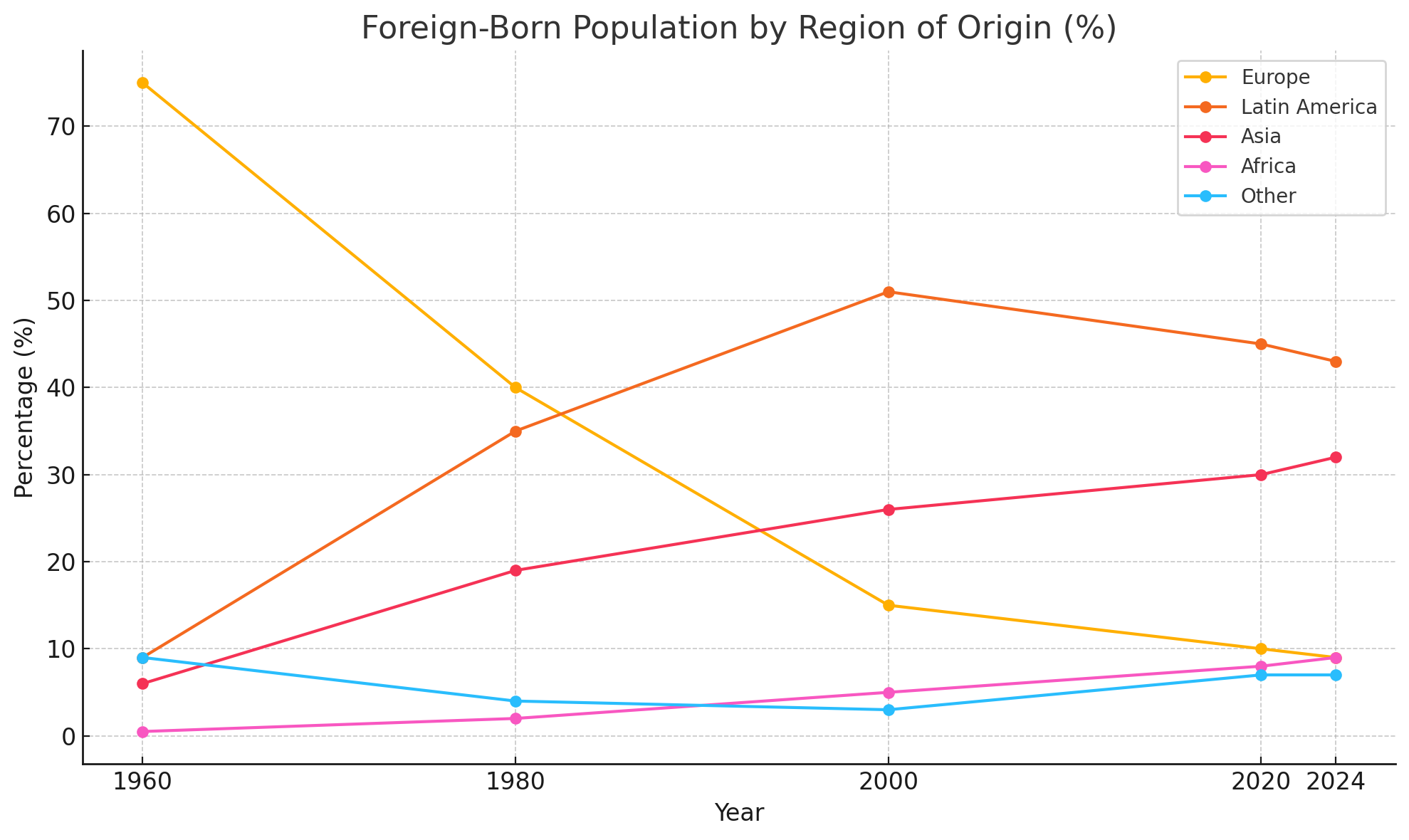
Immigration has always been a cornerstone of the American story. But over the past 60 years, the origins of the U.S. foreign-born population have changed dramatically — shifting from a Europe-dominated pattern to one led by Latin America, Asia, and more recently, Africa. These demographic transformations reflect both global trends and U.S. immigration policy reforms.
Racial Diversity Growing Rapidly: Non-Hispanic Whites are no longer a supermajority. By 2045, the U.S. is projected to be “minority-majority.”
Regional Power Shift: The South and West are economic and population growth engines.
Religious Landscape is Secularizing: Protestants and Catholics are declining; the religiously unaffiliated are growing fastest.
Immigration Patterns Have Shifted: From European-dominated to Latin American and Asian-majority since 1965’s Immigration and Nationality Act.

Global stock markets remained mixed today as investors weighed fresh U.S. inflation data, corporate earnings reports, and the ongoing economic uncertainty in China and Europe. The U.S. stock market opened slightly higher on Monday morning, with the Dow Jones Industrial Average rising 0.4%, the S&P 500 climbing 0.3%, and the Nasdaq Composite gaining 0.5% in early trading. Investors responded positively to June's U.S. Consumer Price Index (CPI) report, which showed inflation cooling slightly to an annual rate of 3.0%, down from 3.3% in May."Markets are optimistic that the Federal Reserve may pause or even cut interest rates by the fall," said Lisa Raymond, chief analyst at Morgan & Co. "But it's still a wait-and-see situation, especially with more earnings coming this week." Wall Street Opens Higher Dow +0.4%, S&P 500 +0.3%, Nasdaq +0.5% on Monday morning. Boosted by June CPI showing inflation cooled to 3.0% (down from 3.3%). Hopes rise for potential Fed rate cut or pause by fall. The U.S. stock market opened slightly higher on Monday morning, with the Dow Jones Industrial Average rising 0.4%, the S&P 500 climbing 0.3%, and the Nasdaq Composite gaining 0.5% in early trading. Investors responded positively to June's U.S. Consumer Price Index (CPI) report, which showed inflation cooling slightly to an annual rate of 3.0%, down from 3.3% in May. "Markets are optimistic that the Federal Reserve may pause or even cut interest rates by the fall," said Lisa Raymond, chief analyst at Morgan & Co. "But it's still a wait-and-see situation, especially with more earnings coming this week." Tech Leads the Way Technology stocks led the gains in the U.S., with Apple (AAPL) up 1.8% and Nvidia (NVDA) jumping 2.4%, as demand for AI and semiconductors remains strong. Tesla (TSLA) also rebounded, rising 3.1% after announcing better-than-expected Q2 vehicle deliveries. Global stock markets showed a mixed performance as investors weighed persistent inflation concerns against a wave of corporate earnings reports. While strong results from major tech companies helped lift some indexes, uncertainty surrounding central bank policies and the future path of interest rates kept others in check. In the U.S., Europe Struggles on Growth Concerns Meanwhile, European markets showed little movement, with the FTSE 100 in London flat and Germany’s DAX down 0.2%. Investors remain concerned about weak industrial output and rising energy costs across the Eurozone.“The European economy is showing signs of fatigue,” said Carla Dupont, economist at BNP Paribas. “High borrowing costs and geopolitical tensions are dragging down business activity.”Global stock markets showed a mixed performance as investors weighed persistent inflation concerns against a wave of corporate earnings reports. While strong results from major tech companies helped lift some indexes, uncertainty surrounding central bank policies and the future path of interest rates kept others in check. In the U.S., Market Performance Summary Table Region Index/Company Movement (%) Key Driver USA Dow Jones +0.4% Positive CPI report (3.0% inflation) S&P 500 +0.3% Rate cut optimism Nasdaq +0.5% Tech stock gains Apple (AAPL) +1.8% Strong AI demand Nvidia (NVDA) +2.4% Semiconductor growth Tesla (TSLA) +3.1% Strong Q2 deliveries Europe FTSE 100 (UK) 0.0% Flat due to economic uncertainty DAX (Germany) -0.2% Weak industrial output, high energy costs Asia Nikkei 225 (Japan) +0.6% Strong export performance Shanghai Composite -1.2% Property sector risks, low consumer spending Asia Mixed as Chinese Markets Slump In Asia, markets showed mixed results. Japan’s Nikkei 225 gained 0.6%, supported by strong export data. However, Chinese markets fell sharply, with the Shanghai Composite down 1.2%, as fears about the country’s property sector and sluggish consumer spending persisted. Gains in consumer and tech sectors pushed markets higher, but weaker-than-expected bank earnings and inflation-related jitters limited broader momentum. European markets edged lower as traders grew cautious about global trade tensions and slowing growth indicators, while Asian markets saw mixed results, with Hong Kong posting modest gains and Tokyo slipping slightly. Overall, market sentiment remains cautious as investors await further economic data and guidance from central banks. Looking Ahead Investors are now turning their focus to key corporate earnings this week from major banks like JPMorgan Chase, Goldman Sachs, and Citigroup, as well as tech giants like Netflix and Microsoft. The results are expected to provide a clearer picture of business resilience amid high interest rates and uncertain global demand. Overall, market sentiment remains cautious as investors await further economic data and guidance from central banks.
The U.S. Supreme Court issued a landmark ruling on Monday, declaring that former presidents are entitled to partial immunity from criminal prosecution for actions taken while in office. The 6-3 decision, split along ideological lines, has triggered intense political and legal debate across the country. The ruling stems from charges brought against former President Donald Trump, who has faced multiple indictments related to alleged interference in the 2020 presidential election and events surrounding the January 6 Capitol riot. The Court’s decision now makes it more difficult for prosecutors to pursue charges for actions deemed as part of a president's official duties. Heatwave Grips U.S. South and Midwest, Breaking Temperature Records Data Table Price Total 1200 1200 Ata Moyda Demographic Data District Population Percentage Noakhali 31,000,00 5% Cumilla 35,000,00 5.5% Divided Reactions President Joe Biden responded to the ruling by calling it a “dangerous precedent” that could place future presidents above the law. “No one in America should be beyond accountability,” he said during a press conference. Republican leaders, however, welcomed the decision. House Speaker Steve Scalise stated, “This ruling upholds the constitutional separation of powers and protects the office of the presidency from political attacks.” What the Ruling Means The Court ruled that while presidents do not have absolute immunity, they are shielded from criminal prosecution for actions that are “within the outer perimeter of official presidential responsibilities.” However, personal or unofficial actions remain subject to prosecution. Legal experts say the ruling could delay several of Trump’s ongoing legal cases, potentially impacting the 2024 election season, where Trump remains the leading Republican contender. Public Response Protests erupted in major cities including New York, Los Angeles, and Chicago, with citizens expressing fears that the decision could weaken American democracy. On social media, the hashtag #NoOneAboveTheLaw trended nationwide.
Tourism Rebounds Strongly in 2025 as Travelers Seek New Adventures Post-Pandemic The global tourism industry has entered a period of remarkable recovery in 2025, following several years of pandemic-related disruption. With the lifting of most travel restrictions, renewed consumer confidence, and a deep craving for exploration, tourism has surged across continents. Experts say this rebound is not merely a return to old patterns, but a reshaping of how people travel, what they value, and how the industry responds. International Travel Reaches Record Levels Countries around the world have seen a significant rise in international arrivals. Popular destinations like France, Thailand, Italy, and Mexico are reporting visitor numbers that not only match but exceed pre-pandemic figures. Airports are bustling, cruise ships are sailing at full capacity, and global airlines have reinstated and even expanded routes. This surge is being driven by both leisure and business travelers eager to reconnect with the world. Tourists Demand Deeper, More Meaningful Experiences Travelers in 2025 are no longer satisfied with generic sightseeing tours. There is a growing demand for immersive experiences—whether it's living with a local family in a remote village, joining a traditional cooking class, or volunteering in conservation projects. This shift reflects a deeper desire for cultural understanding, personal growth, and making lasting memories, rather than just collecting passport stamps. Technology Transforms the Travel Experience Advancements in technology have revolutionized every stage of the travel journey. From AI-powered itinerary planners and mobile boarding passes to biometric check-ins and real-time translation apps, modern travelers are enjoying unprecedented convenience. Virtual reality previews and augmented reality tours are also helping travelers plan smarter and engage more deeply with destinations. Sustainability Becomes a Core Concern Post-pandemic travelers are more environmentally conscious than ever before. Eco-tourism has moved from niche to mainstream, with tourists choosing green-certified hotels, carbon offset flights, and low-impact transport options. Many are also seeking out destinations that emphasize environmental protection, wildlife preservation, and sustainable development. Tour operators and governments are responding by investing in responsible travel infrastructure and education. Flexible Booking and Safety Measures Still Matter Despite the easing of global health threats, travelers remain cautious. Flexible booking policies, free cancellations, and comprehensive travel insurance are considered essential. Tourists also favor destinations with clear safety protocols and reliable healthcare systems. These preferences are shaping the policies of airlines, hotels, and tour agencies, which now compete not only on price and location but on traveler assurance. Domestic and Regional Tourism Remains Strong While international travel has boomed, domestic tourism has also seen steady growth. Many travelers are discovering hidden gems within their own countries—national parks, cultural heritage sites, and lesser-known towns—thanks to local government campaigns and improved transportation networks. Weekend getaways, road trips, and regional cruises are more popular than ever, helping stimulate local economies and reduce pressure on overcrowded hotspots. Travel Trends Are Redefining Industry Standards. From "workcations" that blend business with leisure to solo female travel and multi-generational family trips, the diversity of travel preferences is expanding. Social media continues to influence destination choices, while personalized travel experiences—tailored by data and AI—are raising expectations across the industry. The result is a tourism ecosystem that is more agile, inclusive, and innovative.
In an increasingly visual world, photography has evolved far beyond a hobby—it has become a powerful tool of connection, identity, and even resistance. From the alleyways of Marrakech to the streets of Tokyo, people around the globe are using photography to capture their realities, share their truths, and reimagine how we see the world. In 2025, the art of photography is no longer limited to professionals or those with expensive equipment. With powerful cameras embedded in nearly every smartphone and editing apps accessible to all, the global population has become a generation of storytellers. A New Language of Expression Photography has become the most universal visual language—transcending borders, politics, and even spoken words. A single image can spark movements, ignite conversations, and bring attention to marginalised voices. From the war-torn zones of Gaza and Ukraine to peaceful protests in Europe and climate marches in South America, everyday citizens are documenting history in real time. These raw, unfiltered images often make their way to global audiences faster than traditional news media. "The smartphone is the new pen," says French photojournalist Camille Laurent. "People don’t just take photos—they share their worldviews." The Rise of Visual Identity In cities like New York, Seoul, and Berlin, photography has become deeply intertwined with personal branding. On platforms like Instagram and Threads, visuals are the currency of influence. Whether it’s fashion, travel, activism, or mental health, photography is the lens through which individuals craft and project their identity. This has also sparked a global aesthetic—where minimalist cafes in Istanbul resemble those in Paris, and sunlit "golden hour" selfies are universal. Yet within this visual sameness, cultural uniqueness is also being celebrated. Photographers are reclaiming their heritage—using traditional attire, rural landscapes, and local rituals to tell stories that challenge stereotypes and global homogenisation. AI, Ethics & The Future As artificial intelligence blends with photography, questions of ethics and authenticity are surfacing. AI-generated portraits and edited realities raise concerns about truth, body image, and media manipulation. Yet, at the same time, AI tools are empowering more people to create stunning visuals without formal training—democratising creativity in ways never imagined. "We're entering an era where the line between photography and digital art is blurring," notes Japanese visual artist Rei Nakamura. "But the emotion behind the image still matters most." A Global Bond In refugee camps in Jordan, schoolchildren are given disposable cameras to capture their lives. In Scandinavian forests, nature photographers use drones to document wildlife. On African coastlines, photographers are preserving indigenous stories that were never written down. Despite the diversity of context, one thing is clear: photography connects humanity. It offers empathy. It builds bridges. In the words of American photographer Dorothea Lange, "Photography takes an instant out of time, altering life by holding it still." And today, more than ever, the world is watching—frame by frame.
Seven years after its debut, WWE Evolution returned with gusto—and a renewed mission—by staging an all-women’s flagship event on Netflix and Peacock at State Farm Arena, attended by 8,351 fans. The electrifying main event saw Naomi cashing in her Money in the Bank contract mid-match to defeat Iyo Sky and Rhea Ripley, capturing Raw’s Women’s World Championship in a stunning triple-threat finish. Wikipedia Earlier on the card, Naomi lost a brutal No Holds Barred match to Jade Cargill, officiated by special referee Bianca Belair, underlining the night’s intensity. Supporting matches featured Tiffany Stratton retaining SmackDown’s Women’s Championship by defeating Trish Stratus, while Becky Lynch held Raw’s Women’s Intercontinental title in a triple-threat victory over Lyra Valkyria and Bayley. Later, Stephanie Vaquer won the Evolution Battle Royal to earn a title match at SummerSlam in Paris. Wikipedia This second Evolution event marks more than a sequel it signals WWE's recommitment to women’s wrestling as a premier attraction, elevating full-length women-only PPVs into mainstream platforms and global streaming services. Wikipedia Critics and fans alike praised WWE’s strategic shift: Evolution’s placement on Netflix and Peacock made it accessible globally, while the inclusion of talent across Raw, SmackDown, and NXT demonstrated a unified female roster elevation. Industry analysts see this event as a potential turning point for gender representation in wrestling entertainment. Amid the broader week of sports stories, WWE Evolution stands out as a cultural moment—spanning athleticism, storytelling, and inclusivity. As SummerSlam approaches, the ripple effects from Evolution’s success are expected to shape future female-centric main events.



In an increasingly visual world, photography has evolved far beyond a hobby—it has become a powerful tool of connection, identity, and even resistance. From the alleyways of Marrakech to the streets of Tokyo, people around the globe are using photography to capture their realities, share their truths, and reimagine how we see the world. In 2025, the art of photography is no longer limited to professionals or those with expensive equipment. With powerful cameras embedded in nearly every smartphone and editing apps accessible to all, the global population has become a generation of storytellers. A New Language of Expression Photography has become the most universal visual language—transcending borders, politics, and even spoken words. A single image can spark movements, ignite conversations, and bring attention to marginalised voices. From the war-torn zones of Gaza and Ukraine to peaceful protests in Europe and climate marches in South America, everyday citizens are documenting history in real time. These raw, unfiltered images often make their way to global audiences faster than traditional news media. "The smartphone is the new pen," says French photojournalist Camille Laurent. "People don’t just take photos—they share their worldviews." The Rise of Visual Identity In cities like New York, Seoul, and Berlin, photography has become deeply intertwined with personal branding. On platforms like Instagram and Threads, visuals are the currency of influence. Whether it’s fashion, travel, activism, or mental health, photography is the lens through which individuals craft and project their identity. This has also sparked a global aesthetic—where minimalist cafes in Istanbul resemble those in Paris, and sunlit "golden hour" selfies are universal. Yet within this visual sameness, cultural uniqueness is also being celebrated. Photographers are reclaiming their heritage—using traditional attire, rural landscapes, and local rituals to tell stories that challenge stereotypes and global homogenisation. AI, Ethics & The Future As artificial intelligence blends with photography, questions of ethics and authenticity are surfacing. AI-generated portraits and edited realities raise concerns about truth, body image, and media manipulation. Yet, at the same time, AI tools are empowering more people to create stunning visuals without formal training—democratising creativity in ways never imagined. "We're entering an era where the line between photography and digital art is blurring," notes Japanese visual artist Rei Nakamura. "But the emotion behind the image still matters most." A Global Bond In refugee camps in Jordan, schoolchildren are given disposable cameras to capture their lives. In Scandinavian forests, nature photographers use drones to document wildlife. On African coastlines, photographers are preserving indigenous stories that were never written down. Despite the diversity of context, one thing is clear: photography connects humanity. It offers empathy. It builds bridges. In the words of American photographer Dorothea Lange, "Photography takes an instant out of time, altering life by holding it still." And today, more than ever, the world is watching—frame by frame.



Dhaka, July 1, 2025 — In a major political development, Prime Minister Sheikh Amin announced a cabinet reshuffle today, appointing five new ministers and reassigning key portfolios in what officials say is a move to accelerate ongoing economic reforms. The Finance Ministry will now be led by veteran economist Dr. Rezaul Karim, while the Ministry of Commerce goes to rising political figure Nasima Haque, marking a notable generational shift in leadership. The reshuffle comes amid public pressure for stronger governance, job creation, and inflation control. Opposition parties have criticized the move, calling it "cosmetic," while analysts suggest it signals a strategic repositioning ahead of the 2026 general elections. The Prime Minister emphasized that the changes aim to "prioritize accountability, efficiency, and public service delivery." Cabinet members are expected to take oath at the Presidential Palace tomorrow morning.


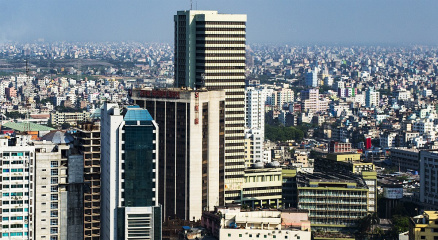
Across the streets of Dhaka and in the pages of once ad-heavy newspapers, a noticeable silence is growing. Billboard spaces remain vacant, newspapers carry fewer colorful full-page ads, and television commercial slots—once crowded with promotional buzz—now often revert to filler programming. The reason: businesses, from manufacturers of mild steel rods to suppliers of everyday food items and consumer electronics, are cutting back on advertising budgets in an effort to survive the growing pressure of economic strain. This pullback signals a deep unease in Bangladesh’s business landscape, where companies are grappling with a confluence of challenges—persistently high inflation, a rapidly depreciating taka, and prohibitively steep bank interest rates—all contributing to an uncertain investment climate. Inflation and Devaluation Fuel the Fire Inflation has been gnawing at consumer purchasing power for months, pushing up the costs of basic goods and eroding profit margins. Even essential items like rice, lentils, cooking oil, and electricity have seen repeated price hikes, forcing families to stretch budgets thinner each month. For businesses, this spells reduced consumer demand, lower sales, and an urgent need to scale back non-essential expenditures—advertising being one of the first casualties.Compounding the problem is the devaluation of the Bangladeshi taka. Over the past year, the local currency has depreciated sharply against the US dollar, making imported raw materials more expensive. For companies dependent on global supply chains, such as electronics retailers or FMCG producers, the cost of production has soared. Rather than absorbing the loss or passing on full costs to customers—who are already reeling from inflation—many businesses are suspending their marketing activities altogether to shore up internal finances. Bank Interest Rates Hit New Heights As part of the government’s strategy to control inflation, the central bank has raised policy interest rates, which has led commercial bank lending rates to spike significantly—often exceeding 13–14%. For businesses, especially small and medium-sized enterprises (SMEs), this has made accessing working capital extremely expensive. Traditional marketing strategies, once considered vital to brand survival and growth, are now seen as luxuries in such a tight credit environment. Instead, businesses are redirecting funds toward managing overheads, servicing debt, or simply staying afloat. As a result, even during major commercial seasons like Eid-ul-Adha and Puja, the volume of advertising—especially print and broadcast—has dropped to levels not seen in over a decade. The Fall in Traditional Media Revenues The cutbacks are taking a toll on the country’s already fragile media ecosystem. Major newspapers and television channels, which rely heavily on corporate advertising for revenue, are seeing their income streams dry up. In the past, a single retail giant or steel conglomerate could purchase several pages of print advertising in a week. Today, media houses are seeing only a fraction of that volume. "This Ramadan, we expected a boost in ad bookings—but it never came," lamented a senior executive at a leading national daily. "Our revenue from advertisements has dropped by nearly 40% compared to the same period last year." For television networks, it's even more concerning. Prime-time slots that would once command top prices from brands promoting mobile phones, detergents, and packaged snacks are now filled with reruns and minimal ad placements. Shifting Focus to Digital, But Slowly Some companies are pivoting toward more cost-effective digital platforms such as Facebook, YouTube, and Google Ads. These platforms allow brands to target specific demographics with smaller budgets, tracking every impression and click. However, not all businesses are agile enough to make this transition, and many still lack the expertise or confidence in digital ROI. “There is interest in digital advertising, especially among the younger brands,” says Nadia Khan, a digital media consultant based in Dhaka. “But budget constraints are limiting even those moves. Many are just pausing all marketing altogether and waiting for more economic stability.” Moreover, digital campaigns may offer reach but can’t replace the credibility or mass impact that traditional platforms like television and newspapers provide—especially in rural or semi-urban areas where internet penetration remains inconsistent. Industry Examples and Sectoral Effects The impact spans across various sectors. In the steel and construction industry, for example, manufacturers of mild steel rods and cement have scaled down promotional activities due to a construction slowdown. Many infrastructure projects are stalled due to lack of funding, and private developers are holding back due to high interest rates on loans. In the fast-moving consumer goods (FMCG) industry, companies producing snacks, bottled beverages, personal hygiene products, and household items have shifted focus toward trade promotions—targeting retailers with direct incentives instead of consumers through ads. Retail electronics has been another major casualty. With prices of imported electronics rising sharply and middle-class purchasing power declining, major brands like Walton, Samsung, and Sony have reduced television and newspaper ads in favor of showroom-level discounts and minimal social media announcements. Even telecom operators—once among the top five advertising spenders in the country—are pulling back. An executive from a top telecom company mentioned, "We're being forced to prioritize core network expansion and subscriber retention over flashy marketing campaigns." Long-Term Implications The ongoing cutbacks in advertising reflect more than just cautious accounting—they signal a broader erosion of business confidence. Prolonged reduction in brand visibility can harm long-term customer loyalty and market share, particularly in competitive sectors. If the current trends continue, industry experts warn of a “brand vacuum,” where even once-dominant names lose relevance due to lack of visibility. For the media industry, the risks are existential. Journalists, production staff, and editors are already facing job insecurity, delayed salaries, and increased workloads. Smaller media houses may be forced to downsize or shut operations altogether if advertising does not recover soon. Looking Ahead There are faint glimmers of hope. The government has signaled that it may look into monetary adjustments later in the fiscal year, potentially lowering interest rates if inflation shows consistent signs of easing. Some banks are also starting to offer sector-specific lending packages at slightly reduced rates, particularly for exporters and manufacturers. Meanwhile, the upcoming fiscal budget may include measures aimed at boosting investor confidence, easing import bottlenecks, and expanding support for small businesses—developments that, if executed efficiently, could help restore the advertising ecosystem. However, industry players agree that a full recovery may still be many months away. Until inflation is under control, the currency stabilizes, and banks offer more accessible credit, most businesses are likely to remain cautious about spending on brand-building. Conclusion: The current lull in Bangladesh’s advertising scene is not just a reflection of corporate thrift but a mirror to a larger economic narrative. Businesses are in survival mode, consumers are cautious, and the media is gasping for breath. Advertising, long considered the engine of consumer economies, has now become a luxury for many. And unless broader macroeconomic challenges are addressed, this advertising drought could leave a long-lasting imprint on the country’s economic and cultural fabric.